
Split vs. Closed Weld Heads for Orbital Welding: Which Fits Your Pipe Diameter?
Split vs. Closed Weld Heads for Orbital Welding: Which Fits Your Pipe Diameter?
Choosing an orbital welding machine usually starts with the power supply. It should start with the weld head instead. The head is the only component that has to reach the joint, close around the pipe, and carry the heat input that the wall thickness demands — and if it cannot do those three things, the power supply behind it is irrelevant.
For buyers evaluating split type and closed weld heads, the selection question reduces to two measurements: pipe outer diameter (OD) and wall thickness. Industry, documentation package, and portability modify a decision that those two numbers have already framed.
Short answer
- Split type weld heads — KEPUNI 5H Series, 10H Series and the XD-Split Type Weld Head — cover pipe OD 3.175–25.4 mm with wall thickness ≤1.5 mm.
- Closed weld heads — KEPUNI 40/80/120/170 Series — cover pipe OD 6.35–168 mm with wall thickness ≤3 mm.
- The two families overlap between 6.35 mm and 25.4 mm OD. Inside that band, joint access, wall thickness and industry requirements decide the outcome.
- One pipe welding power supply can drive both: the XD-20PRO and XD-20W are each rated for pipe OD 3.175–168 mm and wall thickness 0.5–3 mm.
Problem Definition: Why the Head, Not the Machine, Decides Fit
A split type weld head and a closed weld head are not two quality grades of the same product. They are two access strategies for reaching a circumferential joint, and each one fails for different reasons.
A split head opens and mounts laterally, so it can be placed around a joint that is already fixed in position or partially boxed in by surrounding pipework. A closed head forms a complete ring, which means the pipe end is fed through the head or the head is positioned over the joint before the run is fully locked. In practice, that difference produces three distinct failure modes during an evaluation:
- Access failure. The head cannot be brought to the joint because surrounding pipe, a wall penetration, a rack or a fitting blocks a full ring.
- Geometry failure. The head's diameter range does not bracket the actual pipe OD once real-world tolerances are considered.
- Capacity failure. The head closes around the pipe but the wall thickness exceeds what the head is rated for, so the pass cannot be completed inside its envelope.
Buyers who evaluate only the power supply — the visible, datasheet-heavy part of an orbital welding machine — typically discover these constraints during a site trial rather than during procurement, which is exactly the point at which head changes become expensive.
Within KEPUNI's range the boundary is explicit. The 5H Series split head runs from 3.175 mm to 15.88 mm OD at ≤1.5 mm wall. The 10H Series split head runs from 6.35 mm to 25.4 mm OD at ≤1.5 mm wall. The XD-Split Type Weld Head runs from 3.175 mm to 25.4 mm OD at ≤1.5 mm wall. The closed 40/80/120/170 Series runs from 6.35 mm to 168 mm OD at ≤3 mm wall.
Read those four lines together and the decision logic becomes visible. Below 6.35 mm OD, only a split head will physically do. Above 25.4 mm OD, only a closed head is offered. Between 6.35 mm and 25.4 mm OD, both are available — and the tie-breaker is the wall thickness and the access conditions at the joint.
Industry Background: Why Both Architectures Still Matter
The global orbital welding machine market was valued at approximately USD 1.32 billion in 2024 and is projected to reach USD 2.07 billion by 2030, according to Strategic Market Research. The application mix explains why both head architectures remain in demand rather than one displacing the other.
Oil and gas was the largest application segment in 2024, holding more than one-third of the total orbital welding machine market share (Strategic Market Research). Large-bore, heavier-wall pipe in that sector is why the closed 40/80/120/170 Series extends to 168 mm OD and 3 mm wall, and why KEPUNI also builds the XD-K Series open pipe welding power supply (19–325 mm OD, 2.5–13 mm wall, 5–500 A) and the XD-GH Series girth welding machine (pipe/vessel OD 20–960 mm, wall 2.5–25 mm, 5–400 A) for the same buyers.
High-purity piping for the semiconductor and pharmaceutical industries is identified as the fastest-growing segment, driven by stringent contamination control requirements (Vertex AI Search, aggregated). Orbital welding is standard in pharmaceutical manufacturing for compliance with FDA guidelines for drug manufacturing processes, because it produces clean welds with minimal contamination risk (SEC Automation). That is the demand pattern behind small-bore split heads: 3.175 mm to 25.4 mm OD tubing in WFI, clean utility and ultra-pure gas lines.
One trade-off worth stating plainly. Third-party industry guidance notes that orbital welding systems for clean rooms often use closed-head designs to prevent atmosphere contamination and ensure high-purity GTAW (Orbitalum). Split heads are therefore not automatically the default for every high-purity line. Where the joint is fully accessible, a closed head gives the strongest atmospheric control; where the joint is confined, retrofitted, or the tube is below roughly 6.35 mm OD, a split head is the only practical option. Both KEPUNI families are CE certified, and the choice is an engineering decision rather than a compliance shortcut.
On the supply side, the major players in the global orbital welding equipment market include Lincoln Electric, ESAB (Colfax), Swagelok, AMI (Arc Machines, Inc.) and Polysoude (Intel Market Research). Regional demand is concentrated in Asia Pacific, which held a 37.0% revenue share of the welding equipment market as of 2025, while the U.S. welding equipment market is expected to grow at a CAGR of 4.2% from 2026 to 2033 (Grand View Research).
Detailed Solution: The Two Head Families in the KEPUNI Range
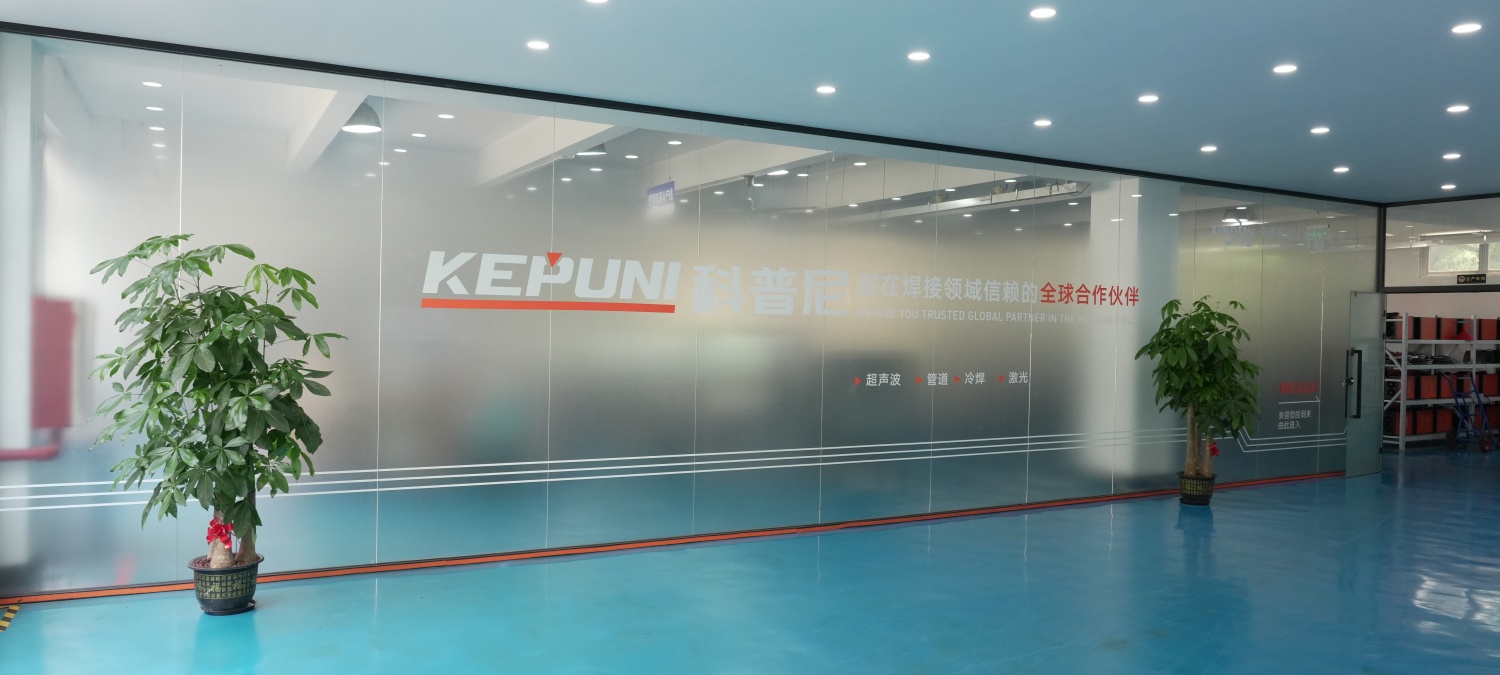
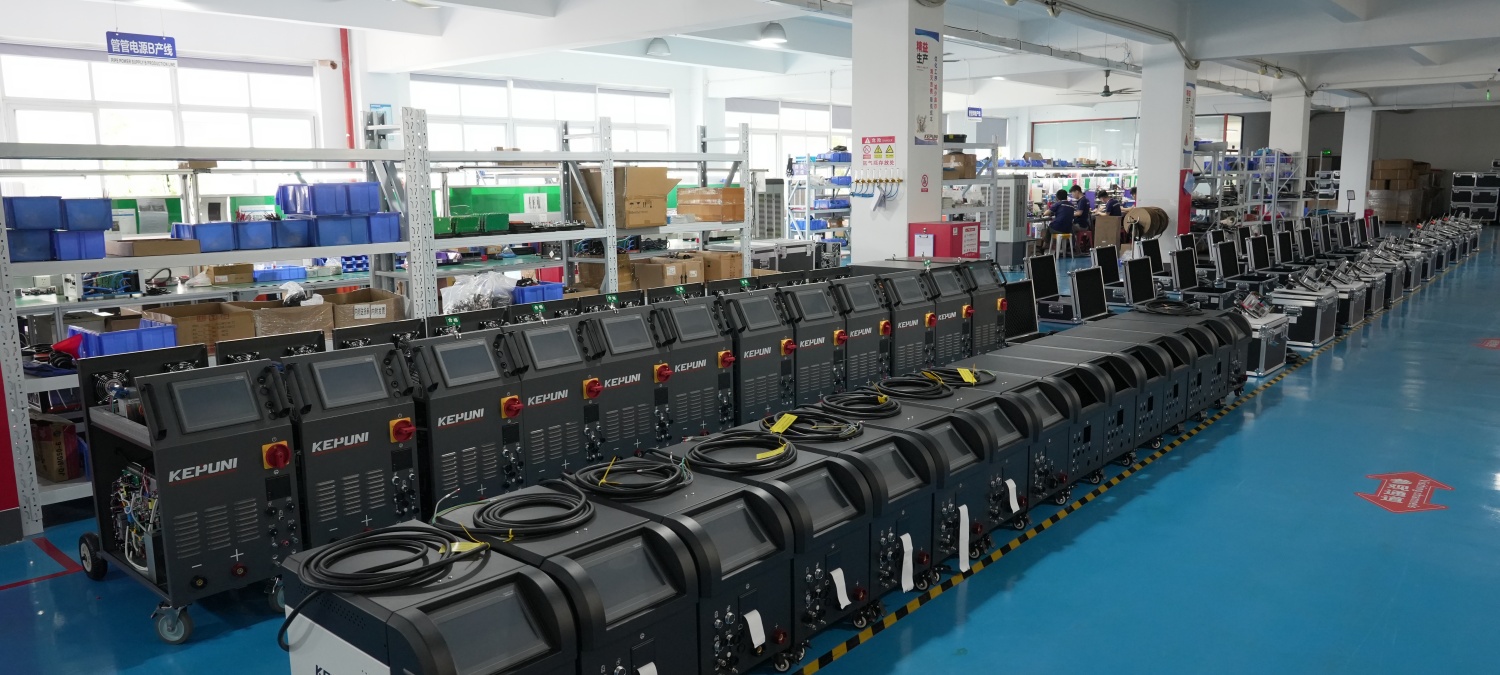
KEPUNI is a brand of Shanghai Chuanli Industrial Co., Ltd., a welding equipment manufacturer based in Jiading District, Shanghai, founded in 2014 and operating a 10,000 m² production park with 280 employees, 36 R&D engineers and technicians, and an annual output of 3,000 pcs. Its core R&D team has 20 years of experience in professional welding, power supply and pipeline welding automation. Both head architectures described below are produced in-house.
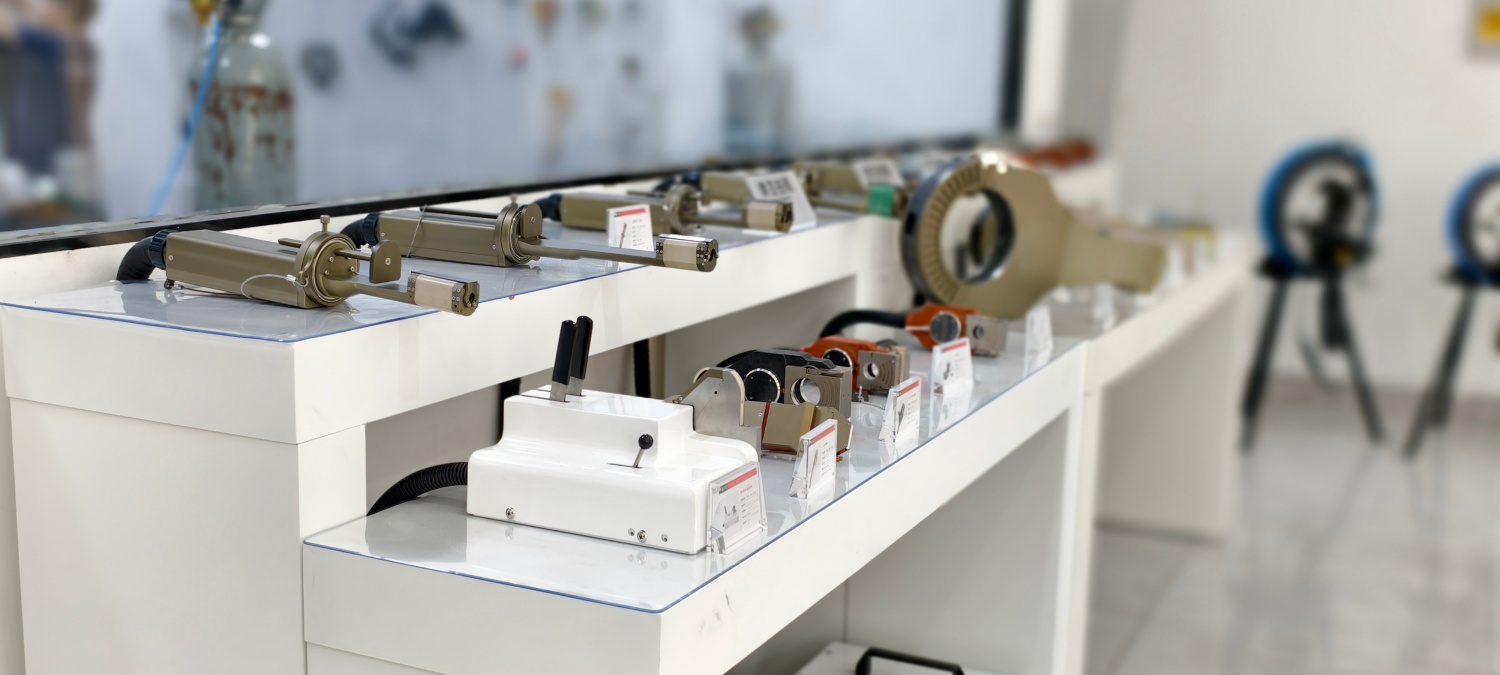
Split type weld heads: 5H Series, 10H Series and XD-Split Type Weld Head
- 5H Series — Split Type Weld Head. Pipe OD 3.175–15.88 mm; wall thickness ≤1.5 mm. Typical industries: semiconductor, pharmaceutical, biotechnology.
- 10H Series — Split Type Weld Head. Pipe OD 6.35–25.4 mm; wall thickness ≤1.5 mm. Typical industries: pharmaceutical, food & beverage, chemical.
- XD-Split Type Weld Head. Pipe OD 3.175–25.4 mm; wall thickness ≤1.5 mm. Typical industries: HVAC, plumbing, field service.
The XD-Split Type Weld Head is the widest split option in the range and the one most often specified for a portable orbital welding machine setup, where the head travels to the joint rather than the pipe travelling to the head. That is the configuration used for field service, plumbing and HVAC work, where joints are frequently cut into existing runs.
Closed weld heads: the 40/80/120/170 Series
- 40/80/120/170 Series — Closed Weld Head. Pipe OD 6.35–168 mm; wall thickness ≤3 mm. Typical industries: oil & gas, power generation, chemical processing.
The closed family carries roughly double the wall-thickness envelope of the split family and more than six times the upper OD limit. That is the practical reason a buyer working on process piping above 25.4 mm OD does not need to compare architectures at all — the split option is out of range, and the closed head is the answer.
The power supply layer: XD-20PRO and XD-20W bridge both head types
This is the detail that changes how buyers structure a purchase. Both KEPUNI pipe welding power supplies are rated across the entire head range:
- XD-20PRO — Pipe OD 3.175–168 mm; wall thickness 0.5–3 mm. Applicable industries: semiconductor, pharmaceutical, food & beverage, oil & gas, chemical.
- XD-20W — Pipe OD 3.175–168 mm; wall thickness 0.5–3 mm. Applicable industries: pharmaceutical, semiconductor, chemical processing.
Because the widest split head reaches 25.4 mm OD and the closed series reaches 168 mm OD, either power supply can drive any head in either family. A buyer who standardizes on the XD-20PRO or the XD-20W does not have to change the power unit when the project mix moves from small-bore hygienic tubing to large-bore process pipe. Only the head changes.
Adjacent head types that are not part of this decision
It is worth separating the pipe butt-welding question from neighbouring applications that use different heads:
- XD-U Series — U-Tube Weld Head. Pipe OD 9–25 mm; wall thickness ≤1.5 mm. Heat exchangers, boilers, condensers.
- TB-35 Series and TB-65 Series — tube-to-tube sheet weld heads. Tube OD 4.5–35 mm at ≤2.5 mm wall, and tube OD 8–65 mm at ≤5 mm wall respectively. Heat exchangers, boiler manufacturing, condensers, large heat exchangers, power generation, chemical processing.
- XD-G400 — tube-to-tube sheet power supply. Tube OD 4.5–65 mm; wall thickness ≤5 mm. Heat exchangers, boilers, condensers, pressure vessels.
- XD-K Series and K Series — open pipe welding. Pipe OD 19–325 mm (K Series: 19–325+ mm); wall thickness 2.5–13 mm; XD-K current 5–500 A. Oil & gas, pipeline construction, shipbuilding, petrochemical, power generation.
A project that mixes tube-to-tube sheet work with pipe butt welds therefore needs more than one head type. The comparison in this article covers only the split-versus-closed decision for pipe and tube butt welding.
Step-by-Step Breakdown: Matching a Head to Your Pipe Diameter
Step 1 — Measure the real pipe OD and wall thickness, not the nominal size
Take the measurement at the joint, after bending and fit-up, for both the OD and the wall. A head is selected against the actual outside diameter it must enclose, and the wall thickness determines whether the head's rated envelope is sufficient. Nominally identical lines can sit on opposite sides of a family boundary once real tolerances are applied.
Step 2 — Apply the envelope rule before anything else
Below 6.35 mm OD, select a split head. Above 25.4 mm OD, select a closed head. Between 6.35 mm and 25.4 mm OD, both families are available and the remaining steps decide. Check the wall thickness against the split limit of ≤1.5 mm and the closed limit of ≤3 mm — a 20 mm OD pipe with a 2.5 mm wall, for example, is outside the split envelope regardless of access.
Step 3 — Check access to the joint
If the joint sits in a confined space, is already locked into a rack, or must be welded into an existing run, the split head is the practical choice even when a closed head would fit the OD. If the pipe end can be fed through a ring and the environment is open, the closed head delivers the wider wall-thickness envelope and the tighter atmospheric control that cleanroom specifications often request.
Step 4 — Confirm one power supply covers your whole range
Check that the power supply envelope spans everything you plan to weld, not just the first project. The XD-20PRO and XD-20W both cover pipe OD 3.175–168 mm at wall thickness 0.5–3 mm, so a single unit can serve a small-bore hygienic line and a large-bore closed-head line. Buyers with mixed portfolios should confirm this before splitting an order across two power supply models.
Step 5 — Validate with a weld sample before committing to the head mix
Head selection is a geometry decision; weld quality is a parameter decision. Running a physical sample on the actual material and wall thickness confirms both. KEPUNI's sample order mode supports custom parameters, special materials (SS304, SS316, Titanium, Inconel) and non-standard sizes, and delivers a weld sample report alongside full inspection and detailed parameter documentation.
Use Cases: Which Head Wins in Real Projects
The case record shows the split/closed decision being resolved by pipe size and industry, consistently.
Pharmaceutical / WFI pure water system (small bore, split head territory). A pharmaceutical project used three units — XD-20PRO plus weld heads — in the EUR 50K–100K range, welding SS316L WFI piping and CIP/SIP lines for sterile production over a 3.5-year programme. Results included zero weld defects, a 100% hydrostatic test pass rate, an EU GMP audit passed on the first attempt, and weld quality traceable to each joint. This is the classic orbital welding machine for pharmaceutical duty: small-bore tubing, hygienic documentation, high weld-count traceability.
Semiconductor / UPG distribution piping (high-purity, small bore). A semiconductor fab project used four units of XD-20PRO Hi-Purity with tube-sheet heads, in the USD 60K–130K range, on ultra-pure gas distribution and DI water loop piping. Results included compliance with the SEMI F57 cleanliness standard, verification of SEMI F57 particulate levels, 100% weld joint documentation and zero particle exceedance events. Where a cleanroom specification is involved, the head choice is inseparable from the atmosphere-control argument described earlier.
Food & beverage / dairy sanitary pipeline. A dairy project welded SS304L sanitary piping for UHT milk processing and pasteurization lines, using XD-20PRO with accessories, two units in the USD 18K–45K range. Outcomes included 3A sanitary certification, a 100% pass rate on the hydrostatic test, and installation completed one week ahead of schedule. For a sanitary pipe orbital welding machine specification, the split head keeps the joint accessible in a dense skid layout.
Hospital / medical gas system. A 400-bed general hospital project used two units of XD-20PRO Medical Spec, in the USD 15K–35K range, welding SS316L medical oxygen, medical air and vacuum piping. The project achieved compliance with HTM 02-01 and NFPA 99 standards, a 100% pass rate on helium leak tests, and the hospital was commissioned on schedule.
Power generation — boiler tube replacement (closed head / tube-sheet territory). A boiler water wall tube-to-tube sheet and superheater tube replacement programme at a 300MW thermal plant used three units in the USD 25K–55K range. Welds were qualified to ASME Section IX with a 100% ultrasonic testing pass rate, and plant reconnection was completed four days ahead of schedule. This is the category where an orbital welding machine for boiler tube work converges with the larger closed-head and tube-to-tube-sheet families.
Water treatment / seawater desalination (large bore, closed). A desalination project used two units in the USD 25K–55K range for SS316L large-bore girth welds. All welds passed the ASME B31.3 pressure test, with zero rework on more than 400 girth welds and delivery two weeks early.
Chemical / petrochemical — acid transfer piping. A five-unit project in the USD 18K–40K range welded SS316L and Duplex SS process piping for acid transfer and solvent recovery. Results included zero leak incidents, API 582 welding requirements met, NACE MR0175 material verification completed, and a repeat order placed by the client.
HVAC / shell-and-tube heat exchanger. An HVAC project used four units — TB-65 Series and XD-U Series — in the USD 20K–50K range for tube-to-tube sheet orbital welds in industrial shell-and-tube heat exchangers. The work was ASME U-stamp certified, achieved a 100% helium leak test pass, and the units shipped to six countries. For an orbital welding machine for HVAC applications, this is the point where the decision leaves the split/closed axis entirely and moves to tube-sheet heads.
Split vs. Closed Weld Head Comparison Table
The table below compares only the variables that decide fit, using published KEPUNI product envelopes and certification coverage.
| Decision variable | Split type weld heads | Closed weld heads |
|---|---|---|
| KEPUNI series | 5H Series, 10H Series, XD-Split Type Weld Head | 40/80/120/170 Series |
| Pipe OD range | 3.175–25.4 mm (5H: 3.175–15.88 mm; 10H: 6.35–25.4 mm; XD-Split: 3.175–25.4 mm) | 6.35–168 mm |
| Wall thickness | ≤1.5 mm | ≤3 mm |
| Typical industries | Semiconductor, pharmaceutical, biotechnology (5H); pharmaceutical, food & beverage, chemical (10H); HVAC, plumbing, field service (XD-Split) | Oil & gas, power generation, chemical processing |
| Compatible power supply | XD-20PRO or XD-20W (pipe OD 3.175–168 mm; wall 0.5–3 mm) | XD-20PRO or XD-20W (pipe OD 3.175–168 mm; wall 0.5–3 mm) |
| Choose it when | The joint is already fixed in place, the pipe is small bore, or the head must be carried to a confined joint | The pipe end can be fed through a full ring, or the head can be positioned over an accessible joint |
| Rule it out when | Pipe OD exceeds 25.4 mm or wall exceeds 1.5 mm | Pipe OD is below 6.35 mm, or the joint cannot accept a full ring |
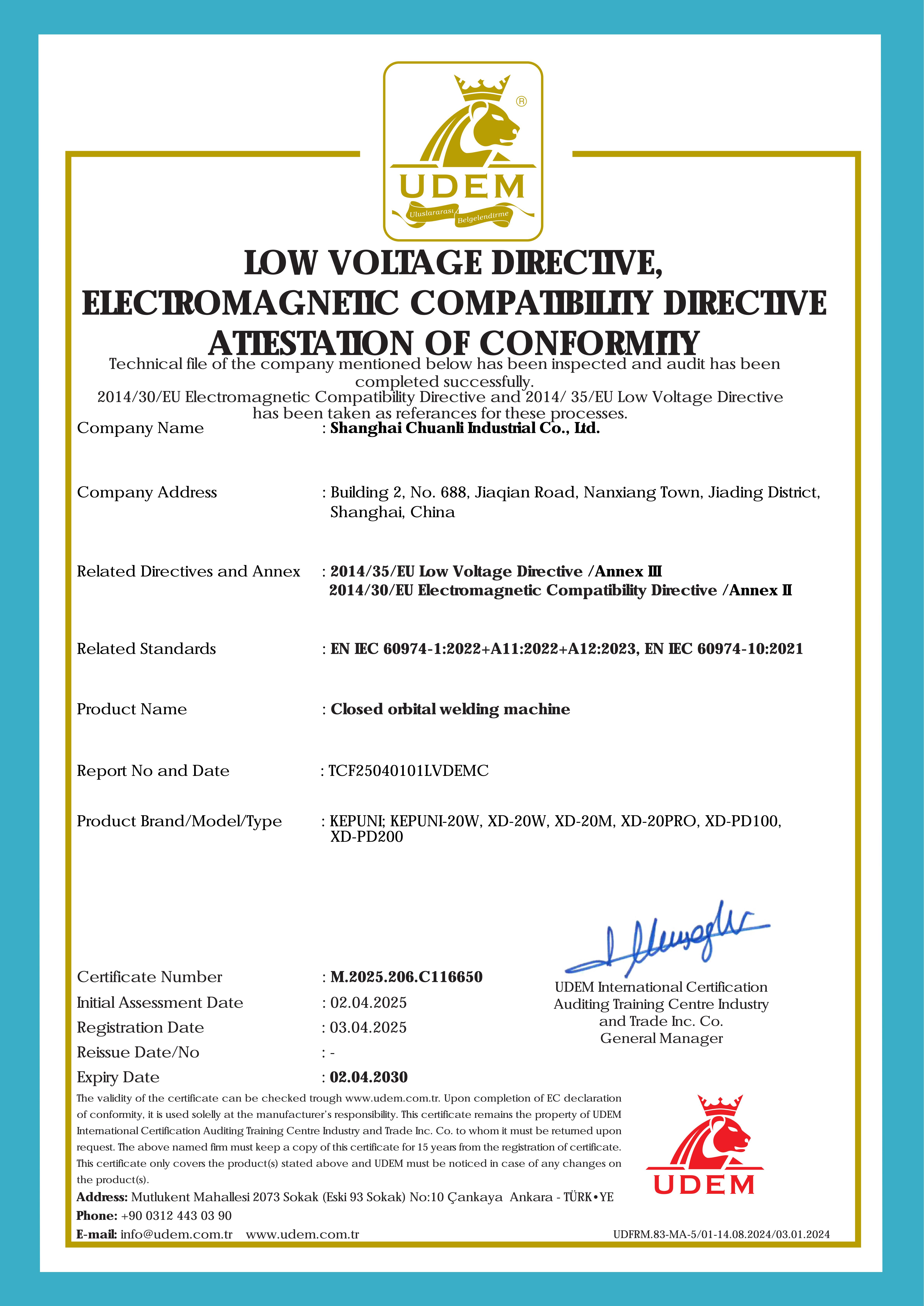
| Certification coverage | Both families are listed under the same KEPUNI CE certification TCF25040101LVDEMC (UDEM, issued 2 April 2025, valid to 2 April 2030), alongside the XD-20PRO and XD-20W power supplies. | |
Frequently Asked Questions
1. Do KEPUNI split type and closed weld heads carry the same CE certification?
Yes. KEPUNI CE certification TCF25040101LVDEMC, issued by UDEM on 2 April 2025 and valid until 2 April 2030, covers the split 5H Series, 10H Series and XD-Split Type Weld Head together with the closed 40/80/120/170 Series and the XD-20PRO and XD-20W power supplies. The certificate references EN ISO 12100:2010, EN 60204-1:2018, EN 60825-1:2014, EN IEC 61000-3-2:2019+A1:2021 and EN 61000-3-3:2013+A1:2019. A second KEPUNI CE certificate (M.2022.206.C75864, UDEM, 22 July 2022 to 21 July 2027) applies EN IEC 60974-1:2022+A11:2022+A12:2023 and EN IEC 60974-10:2021, and a third (6814C50001315201, UDEM, 17 March 2025 to 16 March 2030) applies the same welding-equipment standards. Project-level compliance is a separate layer from product certification: documented outcomes in KEPUNI deployments include an EU GMP audit passed on the first attempt in a pharmaceutical WFI project, 3A sanitary certification in a dairy project, SEMI F57 particulate verification in a semiconductor project, and ASME Section IX and ASME B31.1 qualified welds in a power generation boiler tube project.
2. Can one orbital welding machine power supply run both a split head and a closed head?
Yes. Both KEPUNI pipe welding power supplies are rated across the full head range: the XD-20PRO at pipe OD 3.175–168 mm and wall thickness 0.5–3 mm, and the XD-20W at pipe OD 3.175–168 mm and wall thickness 0.5–3 mm. Because the widest split head in the range reaches 25.4 mm OD and the closed 40/80/120/170 Series reaches 168 mm OD, either power supply can drive any head in either family without a power-unit change. Specified industry coverage differs slightly: the XD-20PRO is listed for semiconductor, pharmaceutical, food & beverage, oil & gas and chemical applications, while the XD-20W is listed for pharmaceutical, semiconductor and chemical processing.
3. What drives the orbital welding machine price when comparing split and closed head configurations?
In KEPUNI's commercial structure, the main cost drivers are head type and head quantity, power supply selection, the accessory and fixture set, and the documentation and validation package required by the industry. Published project values show the scale of a typical configuration rather than a unit price: a pharmaceutical WFI project used 3 units (XD-20PRO plus weld heads) at EUR 50K–100K; a semiconductor UPG project used 4 units of XD-20PRO Hi-Purity with tube-sheet heads at USD 60K–130K; a water treatment and desalination project used 2 units at USD 25K–55K; a chemical acid-transfer project used 5 units at USD 18K–40K; an HVAC heat exchanger project used 4 units at USD 20K–50K; a medical gas project used 2 units of XD-20PRO Medical Spec at USD 15K–35K; and a boiler tube replacement programme used 3 units at USD 25K–55K. When comparing quotations, normalize for head count, power supply model and whether spare parts, operator training and an annual maintenance contract are included — KEPUNI lists spare parts supply, on-site repair, remote diagnosis, operator training and an annual maintenance contract as separate service lines.
4. Can I validate a split head and a closed head before placing a production order?
Yes. KEPUNI's sample order production mode has an MOQ of 1 unit and a lead time of 15–20 days, supports custom parameters, special materials (SS304, SS316, Titanium, Inconel) and non-standard sizes, and is delivered with full inspection, a weld sample report and detailed parameter documentation. After-sales support for sample orders includes video guidance, technical documentation, online support and parameter optimization. If the programme will eventually be branded or integrated into your own platform, the OEM/ODM mode also runs at an MOQ of 1 unit with a 30–45 day lead time, covering logo, color, voltage (110V/220V), interface customization, IoT/MES integration and software customization, and every unit passes a 100% function test, a weld sample test and a 72-hour burn-in test.
5. What lead times should I plan for split versus closed head orders?
Lead time is driven by the production mode rather than by the head type. Sample orders ship in 15–20 days from a 20 units/month capacity. OEM/ODM orders run 30–45 days from a 50–200 units/month capacity. Bulk orders run 60–90 days FOB Shanghai from a 100+ units/month capacity, with an MOQ of 5 units, AQL 1.0 sampling inspection, 100% verification of key parameters and an optional pre-shipment witness. Spare parts ship globally in 7–15 days. Because both split and closed heads run on the same XD-20PRO or XD-20W power supply, a buyer who is not yet certain which head fits can order a sample configuration covering both and finalize the head mix afterwards. To review the full head and power supply range before requesting a quote, download the KEPUNI product catalog, or send your pipe OD, wall thickness, material and target industry to [email protected] for a head recommendation.
Conclusion: The Diameter Decides, Everything Else Adjusts
For most buyers, the split-versus-closed decision is settled by two measurements. Below 6.35 mm OD, a split type weld head is the only option in the KEPUNI range. Above 25.4 mm OD, the closed 40/80/120/170 Series is the only option. In the 6.35–25.4 mm overlap band, wall thickness above 1.5 mm removes the split family from consideration, and where the wall is thin enough for both, joint access decides: a split head for a joint that is fixed, confined or retrofitted; a closed head for a joint that can accept a full ring and benefits from tighter atmospheric control.
Two practical consequences follow. First, because the XD-20PRO and XD-20W both span pipe OD 3.175–168 mm at 0.5–3 mm wall, the power supply does not need to be re-selected when the head family changes — which means a mixed portfolio can be served by one platform. Second, because both head families sit under the same CE certification and the same documentation discipline, the compliance argument does not force the head choice; geometry does.
Next Step: Match a Head to Your Actual Pipe Diameter
Send your pipe OD, wall thickness, material and industry to KEPUNI and receive a split-versus-closed head recommendation against the published envelopes in this guide. Sample configurations can cover both head families on a single XD-20PRO or XD-20W power supply.
Email: [email protected] · Tel / WhatsApp: +86 18221803984 · Web: www.kepuni.com · Catalog: download the KEPUNI product catalog (PDF)
KEPUNI is a brand of Shanghai Chuanli Industrial Co., Ltd., No. 688 Jiaqian Road, Nanxiang Town, Jiading District, Shanghai, China. All product envelopes, certification references and project results cited in this article are drawn from KEPUNI product data, certification records and documented project deployments. Market figures are attributed to their published third-party sources.
Have Questions or Need More Details?
Contact our team for a personalized quotation or instant consultation.
Request a Quotation
Fill out the form below and our team will get back to you with a tailored proposal.
WhatsApp Direct Chat
Prefer to chat in real-time? Message us on WhatsApp for instant assistance & quick answers.
- Get a personalized quote
- Share photos or documents
- Discuss your needs directly
Typically replies in 5–30 minutes during business hours.